
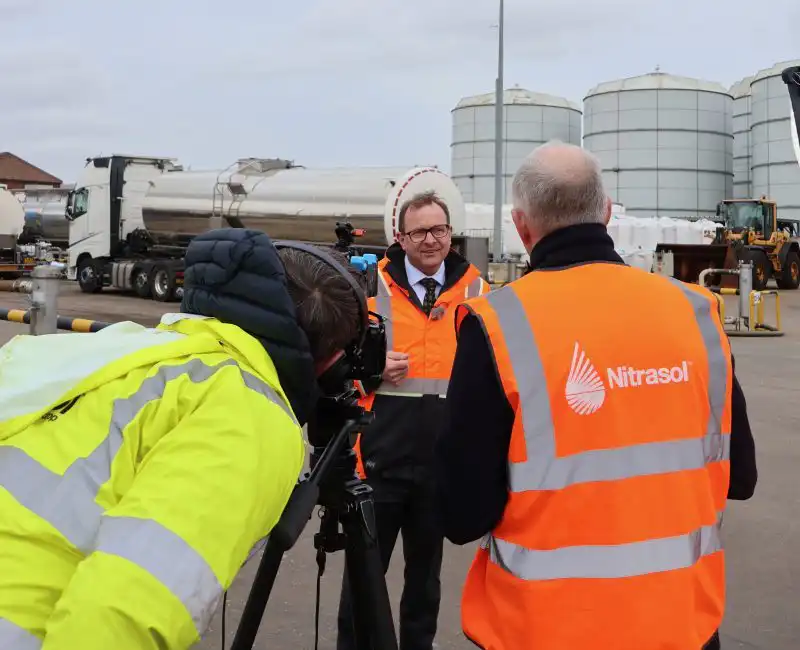
This spring, Sky News visited Nitrasol’s Great Yarmouth terminal to report on how the Iran war and the effective closure of the Strait of Hormuz are driving up fertiliser costs and threatening UK food prices. The cameras shone a spotlight on something farmers have always known but the public often overlooks: without reliable, affordable nitrogen fertiliser, modern food production simply does not work.
Fertiliser at the heart of the food chain
In the Sky News report, Nitrasol’s Great Yarmouth site is shown loading liquid nitrogen fertiliser for farms across Britain, underlining just how central these products are to the entire food chain. As Paul Kelso explains, up to half of global crop and livestock production is thought to depend on synthetic fertiliser, which turns atmospheric nitrogen into plant-available nutrition through energy-intensive processes.
That reliance means fertiliser behaves much like fuel in the system. When gas prices rise or supply routes are disrupted, fertiliser prices follow, and the impact travels quickly from import terminals to farm budgets and, ultimately, to supermarket shelves. The Iran conflict has made this painfully clear, with urea prices having jumped sharply in just a few weeks and growers forced to decide whether to pay more to maintain yields or cut back and risk smaller crops.
How the Iran war has pushed up fertiliser prices
Synthetic nitrogen fertiliser starts with natural gas, which typically accounts for most of the cost of making ammonia, the building block for products like urea and ammonium nitrate. With the Strait of Hormuz effectively closed and a significant share of global ammonia and fertiliser exports normally moving through the Gulf, large volumes of product are now stranded or delayed.
In its recent coverage, Sky News highlighted that urea prices have climbed from around 300 dollars a tonne at the turn of the year to close to 700 dollars by the end of March as a result of these disruptions. Nitrasol’s own recent analysis shows that around one third of global fertiliser supply could be caught on the wrong side of the Strait, putting further upward pressure on prices and squeezing availability just as the European growing season begins. For an import-dependent country like the UK, which now produces less than half the fertiliser it needs at home, that exposure is immediate.
Nitrasol’s role
This is where Nitrasol’s appearance in the Sky News piece matters. At Great Yarmouth, the report shows a steady flow of tankers loading liquid fertiliser sourced from Trinidad, shipped first to Sunderland and then transferred down the North Sea coast. Behind those images sits a deliberate strategy: Nitrasol has invested in deep-water, quayside terminals at Sunderland and Great Yarmouth to bring in large ocean-going vessels from some of the world’s most competitive production regions.
These terminals sit directly on the quay with dedicated pipelines from ship to tank, fully bunded storage, and high-capacity pumping systems, cutting out double-handling and minimising contamination risk. By taking bigger ships from low-cost producers, Nitrasol reduces freight costs and carbon emissions per tonne, while its combined capacity of more than 300,000 tonnes provides a buffer when markets are tight. Crucially for growers, Nitrasol fulfilled every order placed in previous turbulent seasons and continues to honour pre-war prices for customers who bought early, even as replacement cargoes rise in cost.
The link between fertiliser and food security
Lord Fuller’s comments to Sky News echo the argument he recently took to the House of Lords: fertiliser availability and price stability are fundamental to food production and therefore to national food security. When fertiliser costs leap by 25 percent or more, it is not just an issue for farm margins. It raises the cost base for bread, beer, biscuits, butter and meat, the everyday products that appear in almost every shopping basket.
In the worst case, simultaneous shocks from geopolitics and policy risk compound pressure. Nitrasol has warned that layering the planned Carbon Border Adjustment Mechanism (CBAM) on top of an already disrupted global fertiliser market could add another 20–25 percent to nitrogen prices for UK farmers. That combination would make it harder for domestic production to stay competitive and increase the chance that shortages or price spikes translate directly into higher food inflation for consumers.
A resilient fertiliser supply matters to everyone
Sky News framed fertiliser as “the most valuable commodity in agriculture” this spring, and for good reason. When nitrogen is scarce or unaffordable, farmers are forced into false choices between cutting applications and accepting lower yields, or stretching cashflow to preserve production in the hope that prices will later move in their favour.
By building modern, environmentally compliant terminals in Sunderland and Great Yarmouth, sourcing from low-cost regions such as Trinidad, and maintaining strategic stock close to where it is needed, Nitrasol is working to remove as much of that uncertainty as possible from the fertiliser side of the equation. For growers, that means a more reliable liquid nitrogen and nitrogen-plus-sulphur supply at the moments in spring when it matters most. For consumers, it contributes quietly but directly to keeping food on shelves and moderating the spikes in inflation that follow fertiliser shocks.
Are you considering the move to liquid fertiliser? Get in contact with us today to get started.