UAN is the most widely used liquid nitrogen fertiliser in the world, and more UK growers are switching to it every season. If you’re weighing up a move from bagged nitrogen, or you already use liquids and want to understand what’s in the tank, this guide covers what UAN is, how it behaves in the field, how it compares with granular products and how to apply and store it well.
What is UAN fertiliser?
UAN stands for urea ammonium nitrate. It’s a clear solution of urea and ammonium nitrate dissolved in water, usually sold at 28–32% nitrogen by weight.
The strength of UAN is that it delivers nitrogen in three forms at once:
- Nitrate — immediately available to the crop.
- Ammonium — held on soil particles and taken up or converted to nitrate over the following days.
- Urea — converted to ammonium by the soil enzyme urease, giving a steadier release.
Roughly half the nitrogen comes from urea and half from ammonium nitrate. That balance gives the crop a quick start and a sustained supply from a single pass.
Nitrasol’s straight liquid nitrogen grades are UAN Solution 30N and 28N. They’re concentrated, clear and ready to spray — no mixing or dissolving on farm.
UAN with sulphur
Many UK crops, especially cereals and oilseed rape, need sulphur alongside nitrogen. That’s why over two thirds of the liquid nitrogen Nitrasol produces contains sulphur.
Our nitrogen & sulphur grades are UAN solutions with soluble sulphur from ammonium thiosulphate (ATS), from 30N + 10SO₃ through to 24N + 24SO₃. You get both nutrients in one application, and the sulphur supports nitrogen use efficiency and grain protein. If you’re not sure which suits your rotation, our guide to straight liquid nitrogen vs nitrogen & sulphur explains the difference.
UAN liquid fertiliser vs granular nitrogen
| UAN liquid fertiliser | Granular nitrogen (AN, urea) | |
|---|---|---|
| Application | Sprayer boom, even across the full width | Spreader, accuracy depends on granule quality and set-up |
| Nitrogen forms | Nitrate, ammonium and urea together | One or two forms per product |
| Handling | Pumped from tank to sprayer, no bags | Bags or bulk, lifted and loaded |
| Sulphur | Blended in as ATS in one pass | Separate product or a compound grade |
| Storage | Bunded tank, filled by delivery | Covered store, bag stacks or bulk heap |
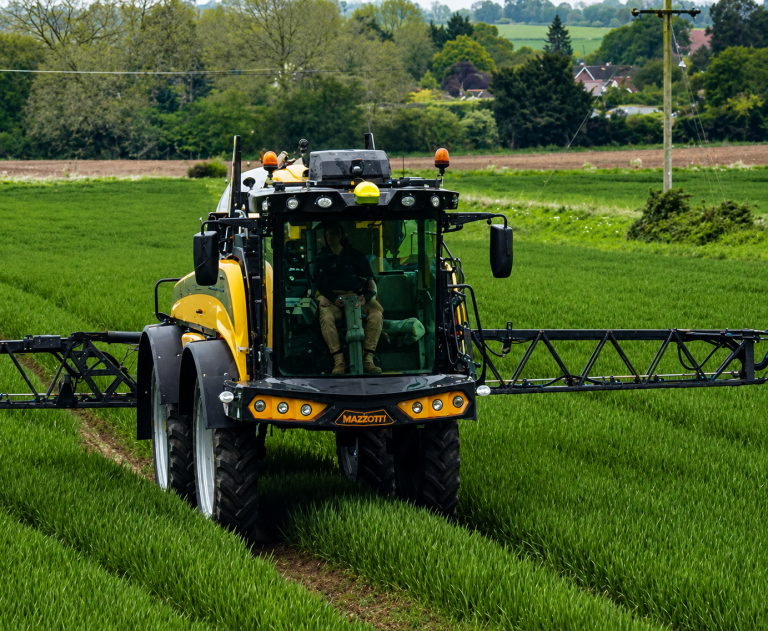
In practice, growers who switch tell us the biggest gains are evenness of application and time. Liquid UAN goes on through the same sprayer you already run, with precision kit such as section control and turn compensation. Our most concentrated 30N + sulphur grades put around a quarter more nitrogen in every tank, which means fewer refills in the busiest weeks of spring.
How to apply UAN
UAN is designed for standard agricultural sprayers. The main change is nozzles: UAN can scorch leaves if applied as a fine spray, so most growers use streaming or coarse-droplet nozzles that get the liquid onto the soil and lower leaves. Our team can advise on nozzle choice for your sprayer.
A few practical points:
- Follow RB209. Match rates and timings to the AHDB Nutrient Management Guide, splitting applications through the season.
- Don’t mix with calcium nitrate products. UAN and calcium-based solutions form a milky precipitate that can block nozzles.
- Clean down after use. Rinse the sprayer and lines at the end of each day’s work.
UAN and the urea rules in England
Because UAN contains urea, it’s covered by the ammonia rules introduced in England from 1 April 2024 through the Red Tractor standard. Fertilisers with more than 1% urea can be applied unprotected between 15 January and 31 March. After 1 April, liquid fertiliser containing urea needs either a urease inhibitor or agronomic justification from a FACTS-qualified adviser on the professional register.
The simplest route is AdvaNShield®, our protected nitrogen range. It meets the Option 4 criteria, can be added to any Nitrasol liquid grade at production or supplied in 10L canisters for on-farm incorporation, and lets you keep applying after 1 April without bespoke justification. In trials, AdvaNShield-protected UAN gave an average 4% yield increase compared with untreated liquid nitrogen.
These rules apply in England. Growers in Scotland, Wales and Northern Ireland follow their own legislation.
How to store UAN liquid fertiliser
Good storage protects your investment and the environment. Liquid fertiliser spills can seriously damage watercourses, and farmers share a duty of care for tanks even when a supplier provides them.
- Bund it. Tanks should sit on a solid concrete base inside a bund holding at least 110% of tank capacity.
- Use the right materials. UAN is corrosive to mild steel, so tanks, valves and pipework must be compatible.
- Secure it. Lock valves when not in use and check fittings before each delivery.
- Think about temperature. UAN can ‘salt out’ (crystallise) in very cold weather. As a guide, standard 28% UAN salts out around −18°C and 30% around −10°C. Check the data sheet for your grade.
Nitrasol’s tank solutions take care of this for you. Our four-step managed conversion includes a site assessment, tank supply and fully managed installation on your prepared concrete base. We anchor each tank against high winds and flotation, match the flanged outlets to your sprayer connections, and record its GPS position so in-season deliveries arrive straight to the right tank. Find out more about our liquid fertiliser tanks.
Why buy UAN from Nitrasol?
Nitrasol is a UK specialist in clear liquid nitrogen. We supply farms nationwide from modern deep-water terminals in Great Yarmouth and Sunderland, delivering direct to your tank. Every litre is backed by FACTS-qualified advice on grades, timing and compliance, and our whole system produces about a fifth fewer emissions than other nitrogen fertilisers used in the UK.
Ready to switch to UAN?
Whether you’re new to liquid fertiliser or reviewing your current supply, our local team can help you choose the right grades and storage. Explore our liquid fertiliser products or get in touch to arrange a site visit.